management: Mainframe Changes In The Past 18 Years
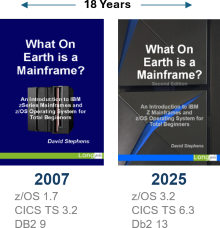
Last year, the second edition of the world's favourite mainframe for beginners' book, "What On Earth is a Mainframe" became available. In the 18 years between releases, there have been a lot of changes to the mainframe and z/OS. Let's look at the big ones: those that would affect a beginner's book.
Hardware
|
Well, the name of the mainframe has changed from zSeries to IBM Z, but it doesn't look much different from the outside. Still have HMCs, still run operating systems like z/VM, z/Linux (now Linux for IBM Z), z/VSE (now 21st Century Software VSEn) and z/OS. Flash storage is now a thing, and IBM announced the first rack-mounted mainframe in April 2023.
The chips themselves are faster and more efficient, with better cache and other features. zAAP processors have gone, and zIIPs rule the day; turbocharged with Simultaneous Multithreading (SMT).
|
|
Not a lot of changes in DASD. In fact, IBM announced the DS8K series in 2004, and it's still sold today. The DASD is a bit smarter and faster, and semiconductor disks are the norm rather than the exception.
Tape is still tape, and we're still using the same 3592 tape cartridges announced in 2003. Of course, they can hold a whole lot more today. The big change is the VTS: now mainstream. Cloud-based storage is also becoming a thing.
Channels are still channels, though FICON now rules the roost. ESCON is history, and no one has used Bus and Tag for a while. But FCP and zHyperLink have crept in, and FICON fabrics with directors and switches are attractive.
Operating System and Subsystems
For the beginner, z/OS basics are the same. Still logon to TSO/ISPF, still run batch. Datasets are pretty much the same, though HFS has been replaced with zFS. UNIX Systems Services is now called z/OS UNIX, and there are some new features like the Z shell and the Data Set File System (DSFS).
There are more 'bells and whistles' included in z/OS, like Websphere Liberty, Apache HTTP server (replacing the old Domino server), and the z/OS Management Facility (z/OSMF). JES3 is now Phoenix Software's JES3plus, and everyone gets JES2 with z/OS. The z/OS health checker helps administrators find 'nasties' and migrate to newer z/OS versions. SDSF has had a renaissance over the past 18 years, providing far more information and features.
z/OS is faster, thanks to things like the sort accelerator and system recovery boost. Encryption is now big, and IBM's pervasive encryption features are attractive.
The cheaper z/OSe for 'next generation e-business' workloads is gone; everyone uses plain old z/OS. IBM software pricing has continued to evolve; Tailored Fit Pricing is the latest.
IMS and CICS still work the same. CICS has added features related to Java, allowed Websphere Application Server to live inside, and handles REST APIs. The IMS catalog makes defining resources easier, and external SQL access via ODBM has been added since 2008. Websphere Application Server (WAS) has had some big changes: the traditional configuration is stabilised, replaced with WAS Liberty. In fact, WAS Liberty is now a base feature of z/OS, used byIBM products like z/OSMF.
For the beginner, Db2 hasn't changed much (other than the earth-shattering name change from DB2), though Db2 experts will tout things like temporal tables, XML, efficiency, better zIIP offload and the ability to store more data. Access to mainframe data has become a bigger issue, and replicating mainframe data outside has become mainstream. Most sites use Db2 DDF, and IMS Connect (and ODBM) is now free with IMS.
Communications
For networking, it's all TCP/IP. No more communications controllers, and Enterprise Extender has become the way to use SNA over IP. Hipersockets provided in-memory communications between systems on the same CEC for years, but SMC-D is the new kid on the block. SMC-R allows communication with other systems playing RDMA.
Web services have taken off, though SOAP has taken a back seat to REST APIs. z/OS Connect provides a REST gateway in and out of the mainframe, and subsystems including CICS, z/OSMF, IBM MQ and Db2 provide REST APIs. Zowe is a big REST user and provider, but we'll get to Zowe in a second.
IBM MQ is now used almost everywhere. Those wanting access to z/OS datasets can no longer use Samba (or SMB), but NFS works nicely. z/OS adds features like the Cloud Data Adapter (CDA) to access cloud object storage, and both IBM and BMC offer a cloud-based tape replacement.
Applications
In many ways, traditional applications haven't changed much. Still use COBOL and PL/I. Still compile and bind programs. Load modules are becoming a thing of the past as current compilers force users to move to program objects.
Some legacy software management tools like Broadcom Librarian and IBM SCLM are on the way out, and Git is becoming the choice for source code management. Free or cheap development tools like Zowe Explorer and Eclipse Che4z now allow developers to develop without 3270.
C and C++ have been on the mainframe for a while, though IBM has introduced a second Open XL C/C++ while retaining the classic compiler. IBM has added new programming languages to z/OS, including Python, Go and JavaScript (using Node.js). Users will like the price tag of most of these: free.
IBM ZOAU allows these new languages to use z/OS resources like jobs and datasets. New features like Zowe and Ansible rely on this new technology.
Zowe is interesting, providing a Windows-like environment for z/OS based on JavaScript. It also opens up the mainframe with a UNIX and Windows command line interface, along with other goodies. As open-source software has never been particularly popular with mainframes, the success of Zowe is interesting. And it's not the only open-source project: the Open Mainframe Project hosts others, including GenevaERS.
z/OS provides features for applications to work with non-mainframe programs and data. The web-enablement toolkit lets programs to send and receive JSON over TCP/IP. The XML Toolkit makes it easier for applications to work with XML data. COBOL also provides built-in features to work with JSON and XML.
The Software Market
The mainframe software market is perhaps where the biggest changes are. You would expect some movement in the vendors with mergers and acquisitions, and the past 18 years haven't disappointed. Giants CA and Compuware were acquired by Broadcom and BMC, respectively. Rocket also went shopping, snapping up ASG and OpenText's software, amongst others.
Vendors have also made some name changes, none as large as BMC moving to the BMC AMI product line.
Many old products have been retired, as we say goodbye to old IBM favourites like Ada, JES328X and MERVA. Other vendors have also trimmed their legacy offerings. Some old products retired by IBM have been given a second life by other vendors. For example, IBM InfoMan is now Log-On TVL Information Management for z/OS.
The incoming software products are interesting. Linux programs can now run on z/OS using IBMs z/OS Container Extensions (zCX), and products like Precisely Ironstream and IBM Common Data Provider (CDP) stream data in real time from z/OS to things like Splunk and ELK.
Mainframe Issues
Many mainframe issues remain the same. Still need to keep software up to date, still need to manage and support applications. Still need the same people to maintain the mainframe, still have issues finding them. Still need to keep the mainframe running, still need to manage costs and plan for a disaster.
Mainframe modernisation is perhaps a bigger issue than it was 18 years ago, as sites continue to look for ways to move from the mainframe, or at least make it look more like the rest of the IT world.
Basics Still the Same
In many ways, the second edition of "What On Earth is a Mainframe" isn't much different from the first: the basics of mainframes and z/OS are the same.
But that's not to say that the mainframe isn't evolving: this article is full of small and large changes. These aim for easier development and management, but also a mainframe that works with the surrounding non-mainframe world.
David Stephens
|


 Home
| Contact
Us | Site
Map
Home
| Contact
Us | Site
Map